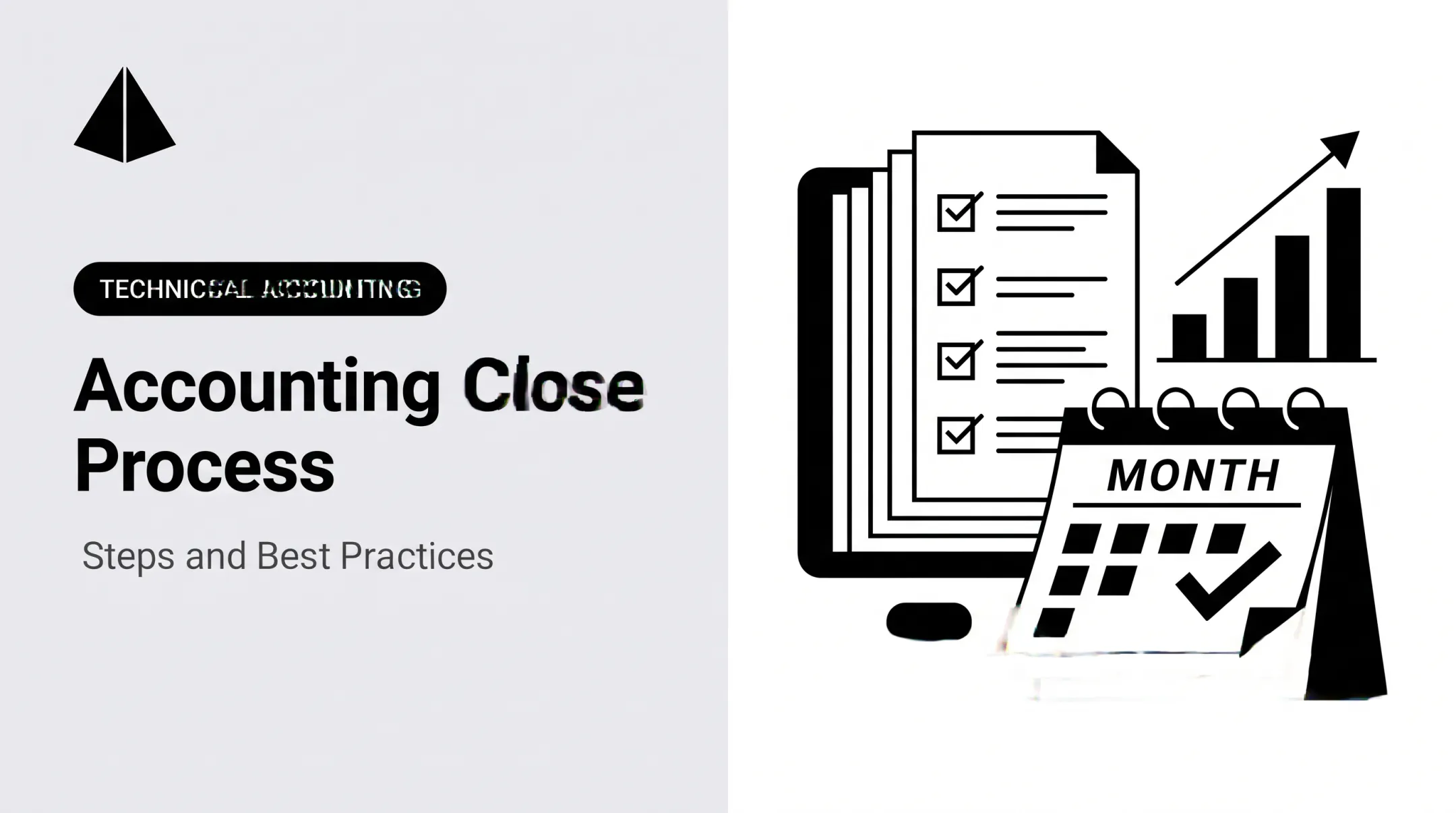

Most people call it "closing the books." But that phrase hides a lot of operational detail. The close involves dozens of dependencies, specific control points, and judgment calls that rarely get discussed outside the accounting department.
This article breaks down what financial close actually includes, how it works from pre-close prep through final reporting, what factors determine whether it runs smoothly or badly, and when it might be time to bring in outside help.
Key Takeaways
- Financial close is a recurring process that produces a reliable, period-specific view of financial position and performance
- A complete close depends on transaction capture, cutoff, reconciliations, adjusting entries, review, and final reporting
- Speed should support accuracy and documentation, never replace them
- Standardized ownership and close calendars reduce period-end pressure
- Recurring delays or unresolved reconciliations often signal a need for process redesign or added accounting capacity
What Is the Financial Close Process?
Financial close happens at month-end, quarter-end, year-end, or at another formally established reporting interval. The goal is straightforward: produce a complete, accurate, supported, and appropriately reviewed set of financial records for that specific period.
Financial close and "closing the books" aren't quite the same thing. Financial close covers everything leading up to and including final sign-off: the reconciliations, adjustments, and reviews. Closing the books is the moment the period actually locks, when no further entries can post without special authorization.
Financial Close vs. the Accounting Cycle vs. SAP R2R
These terms get used interchangeably, but they describe different scopes of work:
- The accounting cycle is the continuous, repetitive process of recording transactions as they happen: identifying, journalizing, and posting activity throughout the period
- Financial close is the periodic checkpoint that verifies and finalizes what the accounting cycle recorded
- Record-to-report (R2R), the framework SAP and other ERP vendors use, is broader still. It spans recording, close, consolidation, and reporting as one connected sequence
Financial close is a major component of R2R, not the whole thing.
Month-End, Quarter-End, and Year-End Differences
These three close types share the same core activities (reconciliations, adjustments, and review), but the scope changes considerably:
- Month-end close is typically faster and less formal, focused on internal management reporting
- Quarter-end close adds variance analysis depth, sometimes auditor involvement, and board or lender reporting
- Year-end close is the most intensive: full financial statement preparation, audit support, disclosure requirements, and consolidation across entities where applicable
Why the Financial Close Process Is Used and Where It Applies
Financial close exists because management, boards, investors, lenders, auditors, tax professionals, and regulators all need a common, trustworthy financial record for the same period. Without it, every stakeholder would be working off a different version of the numbers.
Reliable close outputs feed directly into:
- Budgeting and forecasting
- Cash-flow planning
- Profitability analysis
- Covenant and lender reporting
- Board-level decision-making
Single-Entity vs. Multi-Entity Close
Close requirements scale with organizational complexity. A single-entity company reconciles its own accounts and reports its own statements. A multi-entity organization layers on intercompany transactions, consolidation, currency translation, and multiple accounting systems that all need to tie together before anyone can trust the output.
Certain events tend to trigger a more formal or intensified close:
- Month-end or year-end reporting deadlines
- External financing or refinancing activity
- Acquisitions, divestitures, or new investors
- Audits or newly identified control deficiencies
- Changes in accounting policy
Close duration itself varies widely depending on organization size and complexity. APQC's 2026 benchmark found top-performing organizations complete their annual close in 10 days or less, with an 18-day median and 35 days among slower performers.

Organizations under $100 million in revenue post a 10-day median, compared to 23 days for companies between $1 billion and $5 billion. There's no single "right" number; context matters more than the benchmark itself.
How the Financial Close Process Works
The close moves through a sequence: pre-close preparation, transaction capture, reconciliation, adjusting entries, review and reporting, then sign-off and post-close improvement. Inputs typically include:
- General ledger activity and subledger data
- Bank and credit-card statements
- AP/AR records, payroll, and inventory
- Fixed-asset schedules, contracts, and intercompany records
Several control points determine whether the output can be trusted:
- Period cutoff and account ownership
- Materiality thresholds
- Segregation of duties
- Documented review and approval
Step 1: Prepare for the Close
Before the period even ends, the team should:
- Define the reporting period and publish a close calendar
- Assign task owners and reviewers
- Communicate cutoff dates to operating departments
- Handle recurring reconciliations and journal entries that don't need to wait for period-end
Pre-close work spread across the period is what separates a controlled close from a scramble.
Step 2: Capture and Post All Period Activity
The team records revenue, cash receipts, purchases, payroll, AP/AR, inventory movements, debt activity, and leases in the correct period. Cutoff testing matters here. Teams must determine whether a late-arriving invoice belongs in the current period, needs an accrual, or should wait until next month.
Step 3: Reconcile Accounts and Investigate Exceptions
Reconciliations compare general-ledger balances against independent support — bank statements, subledgers, schedules, or confirmations. This typically covers:
- Cash and bank accounts
- Accounts receivable and payable
- Inventory and fixed assets
- Prepaid expenses and accruals
- Debt, equity, and intercompany balances
Preparers document each reconciliation, explain reconciling items, assign corrective action, and route it for independent review.
Step 4: Post Adjusting Entries
This is where technical accounting judgment comes in. Common entries include accruals, deferrals, depreciation, amortization, impairment analysis, allowance estimates, foreign-currency effects, revenue recognition, lease accounting, and tax entries.
Every manual and recurring journal entry needs support, appropriate approval, and a clear audit trail. Skip the documentation and you've created next period's cleanup problem.
Step 5: Review, Consolidate, and Produce Reports
Balance-sheet and income-statement review, flux analysis, and unusual-activity investigation confirm that material movements are understood, not just recorded. Multi-entity organizations add intercompany matching, consolidation adjustments, currency translation, and entity-level sign-off.
Typical outputs at this stage include:
- Trial balances
- Income statement, balance sheet, and cash-flow statement
- Management reporting package
- Disclosure support
Step 6: Finalize, Communicate, and Improve
Final review leads to sign-off and period locking. Approved reports get distributed, and supporting documentation gets retained. Post-close entries require controlled treatment, not ad hoc edits.
The step people skip most often: a post-close review of missed deadlines, recurring reconciling items, and control exceptions. Without it, the same problems repeat every period.

Key Factors That Affect the Financial Close Process
Inputs and Data Quality
Incomplete invoices, late expense reports, unrecorded receipts, duplicate transactions, and inconsistent chart-of-accounts coding all create downstream delays and rework. Deloitte's 2025 report on controllership identifies standardized data as a cornerstone of close efficiency, linking fragmented data sources and manual reconciliation directly to slower, less reliable close performance.
Operating Conditions and Accounting Complexity
Transaction volume, revenue-model complexity, acquisitions, new debt, equity compensation, leases, inventory, and foreign currency all raise the bar. More complexity means more technical judgment, more documentation, and more audit scrutiny.
Systems, Workflows, and Dependencies
Disconnected ERPs, spreadsheets, billing systems, and payroll platforms create handoff problems and reconciliation headaches. Integrations and centralized task tracking help, but software alone doesn't fix a weak process: it just automates the weakness faster.
Scale, Frequency, and Organizational Structure
A simple single-entity close looks nothing like a multi-entity, PE-backed, or acquisition-active close. Continuous accounting (spreading recurring monthly work across the period instead of cramming it into close week) reduces pressure considerably.
One accounting team's experience, documented by the Journal of Accountancy, found that fixing upstream vendor-invoice coding and building cross-training into the team eliminated bottlenecks that technology alone hadn't solved.
Controls, Compliance, and Governance
Core elements include segregation of duties, approval thresholds, evidence retention, and audit trails. Public companies face SEC and PCAOB expectations around internal control over financial reporting. Non-accelerated filers are exempt from the Section 404(b) auditor attestation requirement, so compliance obligations differ by filer status. Privately held companies still benefit from similar discipline, even without the regulatory mandate.

Common Issues, Misconceptions, and When Additional Support May Be Appropriate
Common Issues and Misconceptions
A faster close isn't automatically a better close. Speed without accuracy, documentation, and control just produces wrong numbers quickly. Some other misconceptions worth correcting:
- "Close starts after month-end." In reality, pre-close preparation and continuous reconciliations should absorb most of the work before the formal window opens
- "Completed financial statements mean a reliable close." Not if reconciliations, cutoff testing, or variance explanations are incomplete underneath them
- "One experienced employee can hold the process together." That's a single point of failure, not a process
Common failure patterns include:
- Unclear ownership
- Spreadsheet version conflicts
- Reconciliation backlogs
- Repeated post-close entries
- Unresolved intercompany differences
Delayed reporting usually traces back to late inputs. Recurring audit adjustments usually trace back to weak review. Inconsistent entity reporting usually traces back to missing standardization.
When Additional Support May Be Appropriate
Some signals suggest it's time to look outside the internal team:
- A controller or CAO vacancy, leave of absence, or finance-team restructuring
- A new CFO who needs execution capacity, not just strategy
- Complex revenue arrangements, impairment questions, or new debt and equity structures
- Acquisitions, carve-outs, or purchase accounting deadlines
- Audit disputes or identified control deficiencies
Stratum Advisory Partners, LLC provides tailored accounting and finance advisory support for organizations working through these situations, including financial close and internal control improvement, interim CAO and controller leadership, and technical accounting advisory for complex transactions.
That said, external support isn't always the first move. Isolated timing issues are often solved with clearer ownership, cutoff discipline, and documented procedures before a broader engagement makes sense.
Conclusion
The financial closing process converts a period's raw transaction activity into a reviewed, supported, decision-ready record. Getting there dependably requires coordinated people, accurate inputs, sound accounting judgment, documented controls, and repeatable workflows , not just speed or a new software tool.
When complexity or capacity outpaces what the internal team can handle, the right move is to diagnose the actual source of friction, standardize the process, and bring in specialized or interim support where it's genuinely needed.
Frequently Asked Questions
What are the steps involved in the financial closing process?
It typically includes transaction capture and cutoff, reconciliations, adjusting entries, variance analysis, consolidation when needed, statement preparation, final sign-off, and a post-close review.
What is the SAP R2R process?
SAP's record-to-report (R2R) process is the broader framework for collecting, recording, closing, consolidating, analyzing, and reporting financial data within SAP. Financial close is a major component of R2R, not the entire process.
What is the goal of the financial closing process?
The goal is complete, accurate, supported, and timely financial information for a defined period, produced in a way that meets internal management needs and any applicable external or regulatory requirements.
How long does a financial close usually take?
Timing varies with entity count, transaction volume, systems, and team capacity. APQC's 2026 benchmark found an 18-day median for annual close, with top performers at 10 days or less. Treat those figures as context, not a universal target.
What is the difference between month-end, quarter-end, and year-end close?
Month-end close is generally faster and focused on internal reporting. Quarter-end adds deeper variance analysis and sometimes auditor involvement. Year-end is the most intensive, requiring full financial statements, disclosures, and audit support.
How can a company improve its financial close process?
Start with a documented close calendar, clear account ownership, and earlier reconciliations spread across the period. Add exception management, root-cause reviews after each close, and selective automation or advisory support where capacity gaps remain.