
That's where consolidated financial statements come in. They present the parent and its qualifying subsidiaries as a single economic entity, even though each underlying company remains legally separate. Under ASC 810, this consolidated view is presumed to be more useful than standalone reports whenever a controlling financial interest exists.
This article covers what consolidated statements include, how the consolidation process actually works, when subsidiaries must be consolidated, how consolidated and standalone reporting differ, and what finance teams need to produce reliable results.
Key Takeaways
- Consolidated statements combine the parent's and qualifying subsidiaries' financials into one reporting package.
- Control (not ownership percentage alone) drives the consolidation conclusion under U.S. GAAP.
- Intercompany balances and transactions must be fully eliminated, regardless of noncontrolling interest.
- Reliable consolidation demands disciplined processes, documentation, and sign-off, not just a spreadsheet merge.
What Are Consolidated Financial Statements?
Consolidated financial statements combine the financial results of a parent company and the subsidiaries it controls into one reporting package. The underlying logic comes straight from ASC 810-10-10-1: the group is treated as a single economic entity for the benefit of the parent's owners and creditors, even though each subsidiary remains its own legal entity with its own contracts, tax obligations, and regulatory requirements.
Consolidation doesn't erase those separate legal identities. A subsidiary still owes its own debts, signs its own leases, and answers to its own regulators. What changes is the reporting lens: instead of looking at each entity in isolation, stakeholders see the group as a whole.
The Core Statements and Disclosures
A complete consolidated financial statement set typically includes:
- Consolidated balance sheet: financial position at period-end
- Consolidated income statement: earnings for the period
- Statement of comprehensive income: net income plus other comprehensive income items
- Statement of cash flows: cash activity across the group
- Statement of changes in equity: which can appear as its own statement or within the notes
- Notes and disclosures: consolidation policy, noncontrolling interest detail, and variable interest entity (VIE) judgments where applicable
A Quick Example
Say "Parent Co." owns 80% of "SubCo." Parent Co.'s standalone statements show only its direct assets and its investment in SubCo as a line item. SubCo's standalone statements show only its own balance sheet.
Neither view alone tells a lender the full story of combined revenue, debt, or cash generation. The consolidated statement does, which is why both entity-level and group-level views often matter to different stakeholders.
How Do Consolidated Financial Statements Work?
Consolidation follows a fairly consistent sequence, even though the technical details get complicated fast.
- Identify the reporting entities and determine which ones fall inside the consolidation perimeter based on control.
- Collect trial balances from each entity and align accounting policies and reporting periods so figures are comparable.
- Translate or adjust foreign currency or non-GAAP entries where applicable.
- Combine account balances (assets, liabilities, revenue, expenses, equity, and cash flows) while preserving proper classification.
- Record consolidation adjustments, including eliminations and acquisition accounting entries.
- Prepare disclosures covering consolidation policy, noncontrolling interests, and any VIE-specific judgments.
Intercompany Eliminations
This is where a lot of groups stumble. ASC 810-10-45-1 requires that intra-entity balances and transactions be eliminated in full, not partially, and not in proportion to ownership. Common items that need elimination:
- Intercompany sales and purchases
- Receivables and payables between entities
- Intercompany loans and related interest
- Dividends paid within the group
- Management or service fees charged between entities
- Unrealized profit sitting in inventory or fixed assets that haven't left the group
Here's a simple example: Subsidiary A sells $500,000 of inventory to Subsidiary B. On paper, that's revenue for A and inventory for B. From the group's perspective, nothing left the family: no sale occurred with an outside party.
The consolidated statements must remove that $500,000 entirely, not just Parent Co.'s ownership share of it, per Deloitte's consolidation roadmap.
Acquisition Accounting and Goodwill
When a parent acquires a new subsidiary, ASC 805 governs how that transaction flows into the consolidated statements. At the acquisition date, the acquirer recognizes identifiable assets, assumed liabilities, and any noncontrolling interest at fair value, with some specific exceptions such as acquired contract assets and liabilities under Topic 606.
Goodwill is then calculated as the excess of consideration paid (plus NCI and any previously held interest) over the fair value of identifiable net assets.

This is exactly the kind of work that comes up in real deals. Stratum Advisory Partners' transaction accounting support handles purchase accounting, opening balance sheets, and coordination with valuation specialists so the post-acquisition numbers tie out correctly from day one.
Noncontrolling Interests
When a parent controls but doesn't fully own a subsidiary, the portion it doesn't own is presented as noncontrolling interest (NCI), reported within consolidated equity but separately labeled from the parent's own equity.
Net income and comprehensive income are shown at the full consolidated amount, then split between the parent's owners and NCI. Losses attributed to NCI can exceed its stake in subsidiary equity, creating a deficit NCI balance.
When and How Are Subsidiaries Consolidated?
What matters most is whether the parent controls the entity, not simply how much it owns. Control, influence, and ownership are related but distinct concepts, and U.S. GAAP applies two different models depending on the structure involved.
Voting Interest Entities
For most corporations, ASC 810-10-15-8 points to majority voting ownership (more than 50% of outstanding voting shares) as the usual indicator of a controlling financial interest. But that's a starting point, not a universal rule.
Control can exist through contract or other arrangements even with a lesser ownership stake. Under ASC 810-10-15-10, majority ownership doesn't automatically require consolidation if control genuinely doesn't rest with the majority owner, such as in certain bankruptcy or legal reorganization scenarios, according to FASB's ASU 2015-02.
Variable Interest Entities (VIEs)
Some structures don't fit the voting model at all. A VIE assessment applies when, for example, equity investors lack sufficient capital at risk or lack the typical characteristics of a controlling financial interest. In that case, the reporting entity must evaluate whether it is the primary beneficiary, meaning it has both:
- Power to direct the activities that most significantly affect the VIE's economic performance, and
- An obligation to absorb losses or a right to receive benefits that could be significant to the VIE
No single ownership percentage substitutes for this two-part test.

What Can Change the Conclusion
Consolidation isn't a one-time decision. These events often trigger reassessment:
- A new acquisition or divestiture
- Loss of control through restructuring
- Formation of a joint venture
- New contractual rights or governance changes
Consolidation vs. Equity Method
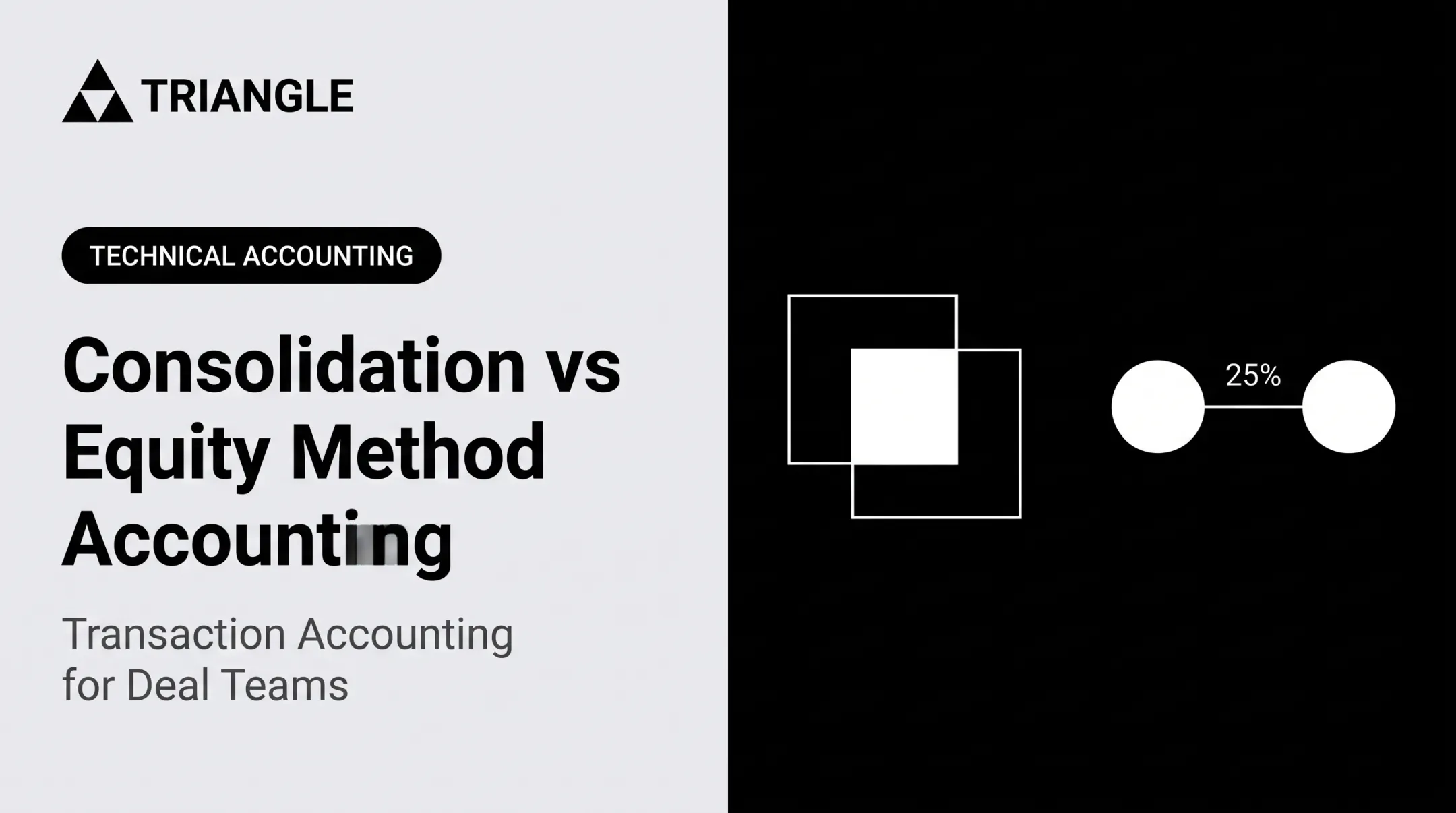
Not every ownership stake leads to consolidation. Under ASC 323, a 20% or greater voting interest creates a rebuttable presumption of "significant influence" (not control), which typically calls for equity-method accounting instead. That means reporting the investment as a single balance-sheet line rather than combining every asset and liability.
Below 20%, the opposite presumption applies. These are presumptions, not consolidation thresholds, and should be verified against the specific facts.
Filing Requirements Are a Separate Question
Whether consolidated statements must be filed depends on entity type, SEC registration status, lender covenants, and investor agreements — not on GAAP consolidation rules alone. SEC-reporting companies typically file Form 10-K annually and Form 10-Q quarterly, but a private company's GAAP consolidation conclusion doesn't automatically create an SEC filing obligation. Each situation should be checked against current FASB and, where applicable, SEC guidance.
Consolidated vs. Standalone Financial Statements
Standalone (or separate) financial statements report on one legal entity only. Consolidated statements report on the parent plus every entity it controls. Both formats answer different questions.
| What you're evaluating | Better served by |
|---|---|
| A specific subsidiary's solvency or cash position | Standalone statements |
| Group-wide profitability and leverage | Consolidated statements |
| Debt covenant compliance tied to one legal entity | Standalone statements |
| Overall investor or lender risk exposure | Consolidated statements |
Consolidated totals rarely equal the simple sum of each entity's separate statements. After intercompany eliminations, acquisition-accounting adjustments, and NCI presentation, the combined revenue, expenses, assets, and cash flows can look meaningfully different from what you'd get by just adding up the individual reports.

Parent-only statements can also be prepared as a supplement to consolidated statements , not a replacement. The SEC's Financial Reporting Manual, for instance, requires parent-only disclosure when a consolidated subsidiary's restricted net assets exceed 25% of consolidated net assets at year-end. That's a narrow, specific trigger , not a general requirement for every company.
Finance leaders, lenders, auditors, and deal advisers frequently need both views side by side. Stratum's transaction accounting work on acquisitions, divestitures, and carve-outs often involves exactly this kind of entity-level versus group-level reconciliation.
Why Consolidated Financial Statements Matter
A parent's standalone statement might look healthy while a subsidiary is quietly bleeding cash, or vice versa. Consolidated reporting closes that gap by showing the full, controlled operation in one view.
That matters for real decisions:
- Acquisitions and refinancing: lenders want to see the group's total leverage, not one entity's slice of it
- Capital allocation: leadership needs to know where cash is actually being generated across the group
- Covenant monitoring: many loan agreements are written against consolidated metrics
- Board reporting and audit preparation: directors and auditors typically expect the group-level picture first
Consolidation also prevents internal transactions from inflating the group's apparent size. Without elimination, intercompany sales would double-count revenue that never actually left the organization.
That said, consolidated statements have limits. They can mask weak performance in a specific subsidiary, since strong results elsewhere in the group can offset it. They also involve real judgment: control assessments, fair value estimates, and NCI attribution all require documented reasoning. Segment disclosures, footnotes, and entity-level schedules remain essential reading alongside the consolidated numbers, not an afterthought.
How to Prepare Reliable Consolidated Financial Statements
Getting consolidation right starts well before month-end close. A practical readiness checklist should cover:
- Legal-entity structure and org chart
- Ownership and control analysis for each entity
- Reporting dates and period alignment across the group
- A unified chart of accounts
- Consistent accounting policies entity to entity
- Mapped intercompany relationships
- Foreign operations and currency translation needs
- Noncontrolling interest calculations
- Standard consolidation entries
Build a Repeatable Intercompany Process
Most consolidation headaches trace back to messy intercompany activity. Fix that by:
- Standardizing counterparty and transaction codes across every entity
- Reconciling reciprocal balances before close, not after
- Setting firm cut-off procedures so transactions land in the right period
- Investigating mismatches immediately, rather than plugging them
- Documenting every elimination entry with supporting detail
Controls and Documentation
Reliable consolidation depends on more than correct math. It needs:
- Consolidation schedules with clear review sign-offs
- Supporting calculations for every judgment call
- Approval trails for significant accounting conclusions
- Version control on working papers
- Retained evidence for anything an auditor will test
When Extra Expertise Helps
Certain events tend to overload internal teams fast: acquisitions, carve-outs, debt refinancing, new revenue arrangements, impairment questions, incentive compensation changes, and new reporting requirements. These are exactly the situations where Stratum Advisory Partners works alongside existing finance teams through:
- Technical accounting advisory for business combinations and impairment analysis
- Transaction accounting support for purchase accounting and opening balance sheets
- Financial close and internal control improvement
- Interim CAO or controller leadership during transitions
Before finalizing any consolidation conclusion or filing, involve qualified accounting advisers and confirm current requirements against FASB, SEC, lender, and contractual guidance. Rules in this area shift, and the specific facts always matter.
Frequently Asked Questions
What is consolidated financial reporting and how does it work?
It's the process of combining a parent company's and its qualifying subsidiaries' financial information into one report, as if they were a single economic entity. Intercompany balances and transactions are eliminated so internal activity doesn't inflate group results.
Is it mandatory to file consolidated financial statements?
It depends on control, the applicable accounting framework, entity type, and whether SEC or other filing requirements apply. There is no universal rule. Each company should confirm its specific obligations rather than assume one standard applies.
What are the methods of consolidation?
Full consolidation combines every asset and liability of a controlled entity; the equity method, used for significant influence without control, reports the investment as a single balance-sheet amount. Which method applies depends on the control assessment under current guidance.
What are the rules for consolidating subsidiaries?
Consolidation hinges on control, assessed under either the voting-interest model or the variable interest entity model, depending on the structure. It also requires consistent accounting policies, full intercompany eliminations, proper noncontrolling interest presentation, and supporting disclosures.